Monday, May 27, 2013

Screening of the new film by Robert Redford - Watershed

Join us for a screening of the new film WATERSHED
The film is Executive Produced and Narrated by Robert Redford and Directed by award-winning filmmaker, Mark Decena, WATERSHED tells the story of the threats to the once-mighty Colorado River and offers solutions for the future of the American West. There will be a discussion after the film and update on current local water issues in the Wimberley Valley.

 http://watershedmovie.com/
 https://www.facebook.com/WatershedMovie
 http://www.twitter.com/WatershedMovie


Date of Event: Wednesday May 29, 2013
Starting Time: 6:30pm
Ending Time: 8:30pm
Cost:  FREE
Location Name: Wimberley Community Center
Location Address: 14068 Ranch Road 12 Wimberley, TX 78676

Executive produced & narrated by Robert Redford
Produced by the Redford Center and Kontent Films


Executive Produced and Narrated by Robert Redford and Directed by award-winning filmmaker, Mark Decena, WATERSHED tells the story of the threats to the once-mighty Colorado River and offers solutions for the future of the American West.

As the most dammed, dibbed, and diverted river in the world struggles to support thirty million people and the peace-keeping agreement known as the Colorado River Pact reaches its limits, WATERSHED introduces hope.

Can we meet the needs of a growing population in the face of rising temperatures and lower rainfall in an already arid land? Can we find harmony amongst the competing interests of cities, agriculture, industry, recreation, wildlife, and indigenous communities with rights to the water?

Sweeping through seven U.S. and two Mexican states, the Colorado River is a lifeline to expanding populations and booming urban centers that demand water for drinking, sanitation and energy generation. And with 70% of the rivers’ water supporting agriculture, the river already runs dry before it reaches its natural end at the Gulf of California. Unless action is taken, the river will continue its retreat – a potentially catastrophic scenario for the millions who depend on it.

In WATERSHED, we meet Jeff Ehlert, a fly fishing guide in Rocky Mountain National Park, Colorado rancher Dan James, Delta restoration worker Edith Santiago, Navajo Council member Glojean Todacheene, Rifle Colorado Mayor Keith Lambert, Los Angeles native Jimmy Lizama and a group of Outward Bound teens rafting down the Colorado River as they all reflect a compelling new water ethic—one that illuminates how letting go of the ways of old can lead to a path of coexisting with enough for all.

The Redford Center created WATERSHED as a inspirational social action tool for people who want to engage. Promoting personal water conservation pledges of 5% – symbolic of the small amount of the rivers’ flow required to reconnect the river to its delta – and garnering donations to help purchase the water rights necessary to restore the connectivity, WATERSHED is a central tool in a larger grassroots effort focused on saving the Colorado River and supporting the communities throughout the river basin.

Contact Information
Wimberley Valley Watershed Association
David Baker

Sunday, May 26, 2013

Even with more money, water problems likely to persist in Texas

By Asher Price - American-Statesman Staff

Even with more money, water problems likely to persist in Texas To hear Texas’ top policymakers talk, the creation of a $2 billion water development fund to help pay for everything from desalination projects to pipelines over the next half-century will avert the state’s water crisis.

Gov. Rick Perry, for one, warned lawmakers that if they did not act, Texas could lose its competitive edge in attracting business to the state. Both Lt. Gov. David Dewhurst and House Speaker Joe Straus put the item at the top of their to-do lists.

The Legislature, in its herky-jerky way, appears ready to deliver. Lawmakers this weekend were putting the finishing touches on legislation creating the fund, including a proposed constitutional amendment asking voters to authorize it.


On paper, then, Texas’ water problem would appear to be largely solved. Yet profound problems persist on the water front, ones the money might do little to sort out.

These include fragmented water planning and regional competition within Texas; frosty relations with neighboring states and Mexico when it comes to sharing water; legal discord between surface water and groundwater interests, even as major water authorities try to meld the two in their supplies; and balancing growing industrial and municipal demands with those of farmers and wildlife.

With the effects of drought evident across the state, Texans are engaged on the issue: Overall, water issues ranked fifth among a list of 10 major issues facing the country, after government spending, health care, the economy and national security, according to a poll commissioned earlier this year by the Institute for Science, Technology and Public Policy at the Bush School of Government and Public Service at Texas A&M University.

But don’t expect lawmakers to return to Austin in 2015 with much appetite for water, said Ken Kramer, who lobbies on water issues for the Texas office of the Sierra Club.
“It’ll be a little bit of an uphill battle,” Kramer said. “If the Legislature acts on a big issue, lawmakers tend to think they’ve taken care of it.”

Lingering problems
Even if voters give the green light to a $2 billion fund that will loan out low-interest money for pipelines and other infrastructure, specific problems could continue to stymie the development of water resources in Texas. Many of them are internecine in nature, with regions of Texas and whole states pitted against one another. They include struggles over reservoir building between water-rich East Texas and the thirsty Dallas-Fort Worth metroplex; a lawsuit between a North Texas water district and Oklahoma; and decades-long claims by Texas officials to get impounded water upstream of the Lone Star State in Mexico and New Mexico.

Within Texas, transferring river water from one basin to another is fraught with territorial and political hurdles. The state’s own water planning process, established by lawmakers in the 1990s as a way to systematically go about forecasting needs, is broken into 16 regions, each of which contemplates only its own demands and supplies.

“It’s essentially a balkanized state planning process,” said state Rep. Lyle Larson, R-San Antonio, who has been deeply involved on a range of water matters. “There’s no dialogue with other regions; there’s no interbasin transfers. Those issues have to be rectified.”

In the meantime, Larson said, Texas officials could be brokering deals with Arkansas, Louisiana, Oklahoma, New Mexico and Mexico. Larson said that beyond simply paying for water, the state can try more creative measures, such as supplying electricity for its neighbors in exchange for water.

Legal complications

Nor is the water money likely to solve thorny legal problems that bedevil water development.
As water authorities such as the Lower Colorado River Authority, which controls the chief reservoirs of Central Texas, branch out from rivers and lakes to supply water in their basins to meet growing demand, they are turning to underground aquifers.

The major problem: In Texas, river and lake water belongs to the state, and underground water belongs to the property owner whose land sits above the aquifer.

That means two different sets of laws and regulatory schemes, creating a nightmare for the river authorities. In the latest example, the LCRA finds itself in a quagmire as it seeks permission from a rural groundwater district to pump water for a Bastrop County power plant.

At the same time, these river authorities and other water suppliers are facing court orders to ensure a steady supply of water for endangered and threatened species in their basins. The state environmental agency and the Guadalupe-Blanco River Authority, which serves Buda, Kyle, San Marcos, Lockhart and Luling, were recently scolded by a federal judge for apportioning too much water for human use and not keeping enough in the Guadalupe River for endangered wildlife.

That case is under appeal.

The water money could eventually be used for pipeline projects that help alleviate that and other problems. Water from the Edwards Aquifer, for example, could be pumped, treated and stored and then piped to the Guadalupe in times of drought.

Conservation effort questioned

Some environmentalists worry that the water money amounts to a state effort to build its way out of this and other problems — rather than encouraging the public to cut back on water use, a cheaper and more efficient way to stretch supplies.

Legislative proposals call for at least 20 percent of the fund to go to conservation projects, but Kramer said that isn’t enough.

“Simply putting money into new infrastructure is working at cross-purposes with things that need more attention, like conservation,” he said. “If people perceive there’s a shortage of water, there’s more of an incentive to cut back on nonessential uses.”

But Laura Huffman, director of the Texas office of the Nature Conservancy, was more bullish about the Legislature’s action.

The conservation earmarks “will enable Texas to significantly reduce the amount of water we use in cities, energy and industry, and agriculture,” she said in a statement.

“Continuing with the status quo would threaten not only our natural resources, but our ability to grow and prosper,” she said.

Thursday, May 23, 2013

In the Flow Vol: 1 Issue: 5:


photo illustration by: Todd Wiseman / Caleb Bryant Miller


UPDATED: House Speaker Joe Straus announced Tuesday evening his plan to delay consideration of a must-pass resolution related to a broader budget deal until Wednesday.  
 announced Tuesday evening his plan to delay consideration of a must-pass resolution related to a broader budget deal until Wednesday.

graphic by: Todd Wiseman / Guillermo Esteves
New changes to House Bill 4, which deals with water infrastructure projects, call for an overhaul of the Texas Water Development Board.
photo by: Claudia Scholz

Scotts Miracle-Gro, a major producer of lawn-and-garden products, has removed phosphorus from a line of lawn fertilizer to help combat harmful algae.

Michael Wines of The New York Times reports on how the rapidly dwindling supply of water in the High Plains Aquifer has hurt farmers from the High Plains to Texas.
graphic by: Todd Wiseman / Pedro Moura Pinheiro

by Mose Buchele, KUT News/StateImpact Texas
A dispute over permitting in the Lost Pines Groundwater Conservation District may foreshadow fights the rest of the state could soon face as crippling drought conditions persist.
Austin-based journalist Ari Phillips documented his travels through Central Texas to learn about the state of the Hill Country's springs and the groundwater underneath them.
graphic by: Ryan Murphy / Todd Wiseman


by Kate Galbraith and Ryan Murphy
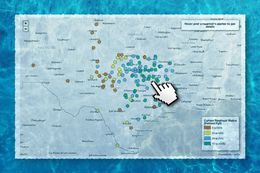
Texas endured the worst drought in recorded state history in 2011, and it has yet to bounce back. Using data from the Texas Water Development Board's reservoir status tracker, our auto-updating map visualizes the current state of Texas reservoirs.
photo by: Callie Richmond


The new film Watershed, produced and narrated by Robert Redford, will be screened at the Wimberley Community Center on May 29.

The Southwest Stream Restoration Conference, which will feature workshops and presentations on stream and watershed management in the Southwest, will be held in San Antonio from May 28 to May 30.


Tell the Governor: Sign SB 198


Governor Perry - Sign SB 198!

Join the thousands of Texans, and many of your neighbors, who want to give homeowners the chance to save water and money! Send a message to the Governor and ask him to sign SB 198 today!

The Texas Legislature passed SB 198, a landmark bill called for by Clean Water Action that would remove the ability of homeowner associations in Texas to ban drought-resistant landscaping, or xeriscaping. Many or most of Texas' HOAs – estimated to number around 25,000 -- have rules in place that require turf grass in all or most of homeowner's front yard. SB 198 is a compromise that will still allow HOAs to give prior approval to, and lay down guidelines for, revisions to a homeowner's front yard, as long as they do not unreasonably restrict or ban xeriscaping.

Now we only need Governor Rick Perry to sign the bill so that thousands of Texans can save water – and money – on their own property if they choose to do so.  Send a message to the Governor today! You can also call him and double your impact - (512) 463-2000

For clean water,
David Foster, State Director

Like Us on Facebook! Follow Us on Twitter! Watch Us on YouTube! Spread the Word! Support Clean Water Action While You Shop with WeCare.com! Donate for Clean Water!
Clean Water Action Austin Office
600 West 28th St, Suite 202 | Austin, TX 78705 | 512.637.9482
Clean Water Action National Office
1010 Vermont Ave | Suite 400 | Washington D.C. | 20005 | 202.895.0420